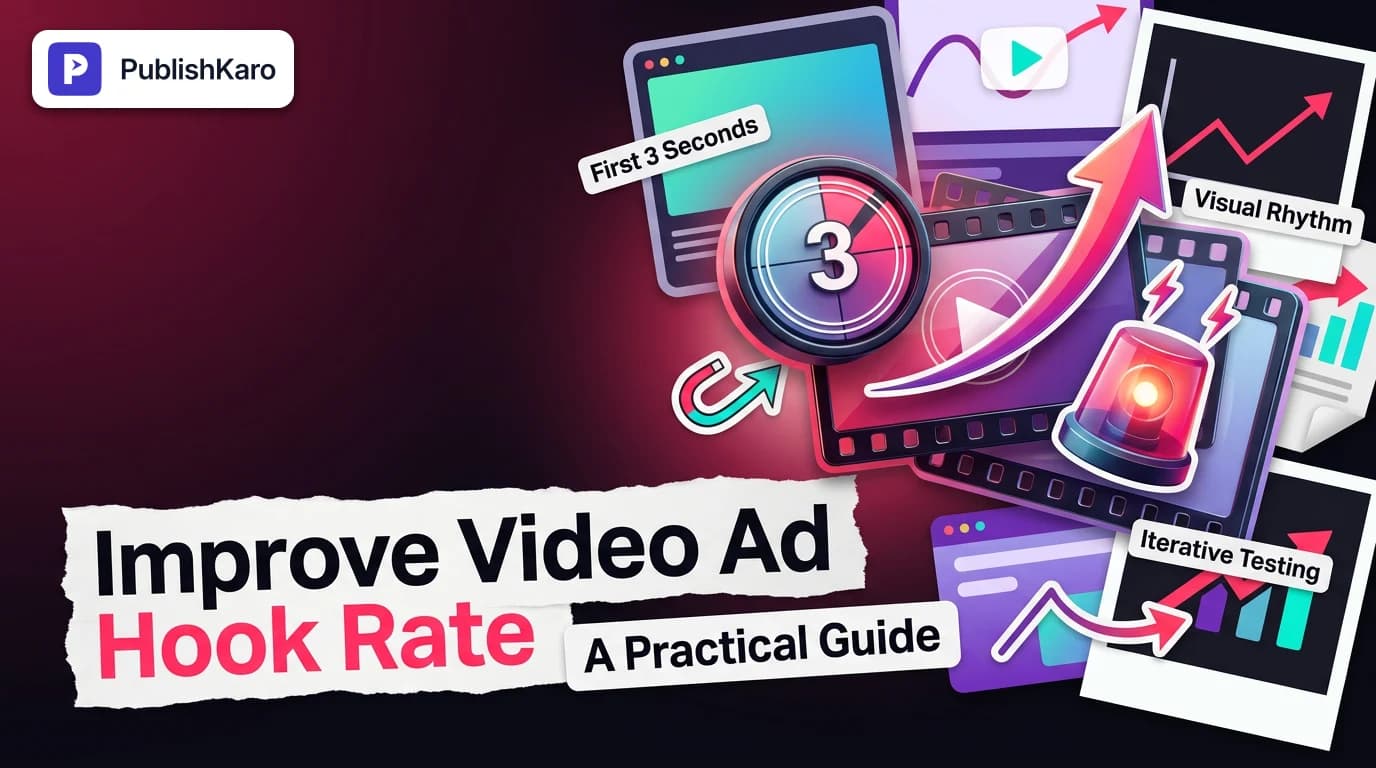
Understanding Video Ad Hook Rate and Why It Matters
In modern paid media campaigns across platforms like Meta, TikTok, and YouTube, user attention is fleeting. Your hook rate—commonly calculated as 3-second video views divided by total impressions—serves as the primary gatekeeper for your entire advertising funnel. If your creative fails to stop the thumb within the opening seconds, your downstream metrics like click-through rates, add-to-carts, and conversions can drop significantly regardless of how compelling your product offer might be.
When running paid campaigns via Meta and Google Ads management, media buyers frequently discover that rising customer acquisition costs stem directly from creative fatigue and weak openings. Understanding the anatomy of an effective hook allows growth teams to diagnose creative failures rapidly without discarding valuable post-click assets. While strong hooks help you capture attention, they do not guarantee specific sales figures or conversion volumes, as downstream factors like pricing, landing page speed, and offer relevance dictate final purchases.
Improving this initial touchpoint also feeds downstream algorithms with positive engagement signals. Platforms tend to prioritize creative assets that retain users longer, often resulting in lower effective impression costs. Reviewing foundational guidance across advertising platforms, such as technical delivery guidelines outlined in the YouTube Help Center, confirms that audience retention within the opening moments dictates overall ad delivery efficiency.
To maintain strong overall performance, digital marketing teams must look at the full picture. You can explore our collection of tutorials on the PublishKaro blog or dive specifically into our video production articles to see how creative and technical strategies intertwine across modern growth campaigns.
The Mechanics of a High-Converting Hook
To systematically diagnose why an audience abandons a video within three seconds, you must break down the sensory inputs delivered during that window: visual pacing, text placement, audio design, and narrative framing.
[0.0s - 0.8s: Pattern Interrupt] -> [0.8s - 2.0s: Problem / Curiosity Trigger] -> [2.0s - 3.0s: Value Proposition Bridge]1. Pattern Interrupts Over Brand Intros
Traditional television advertising encouraged brands to open with establishing shots, company logos, or cinematic fades. On mobile feeds, this approach leads to immediate drop-offs. A modern digital ad requires an immediate pattern interrupt: an unexpected camera angle, physical motion toward the lens, or unconventional framing that breaks the monotonous scroll pattern.
2. Kinetic Typography and High-Contrast Text
A significant portion of social media users consume content with sound muted. If your opening value proposition depends solely on spoken dialogue or voiceover, your message is lost. High-contrast, dynamic text overlays placed in the upper-middle third of the vertical frame ensure immediate readability without colliding with native platform UI elements like handles, captions, or call-to-action buttons.
3. Immediate Context and Stakes
Ambiguity rarely works in direct-response video advertising. Viewers need to understand who the video is for and why it matters to them almost instantly. Introducing a specific pain point, a surprising comparative demonstration, or a counterintuitive statement bridges curiosity into sustained watch time.
If you find your organic distribution suffering alongside your paid efforts, explore our guide on why your Instagram Reels might be getting fewer views to identify platform-wide retention factors.
Step-by-Step Framework: How to Improve Video Ad Hook Rate
Applying a structured process transforms hook optimization from guesswork into an engineering discipline. Here is how growing businesses can systematically evaluate and refine 3-second retention rates.
Step 1: Audit Drop-Off Curves in Ads Manager
Before creating new creative assets, evaluate your historical retention graphs. Locate the exact drop-off percentage between impressions and 3-second continuous plays. Pinpoint whether drop-offs occur at the 1-second mark (visual failure) or the 2-to-3-second mark (narrative failure). Understanding these specific inflection points reveals whether your opening visual failed to stop the thumb or whether your initial messaging failed to build sufficient interest.
Step 2: Strip Out Dead Air and Slow Transitions
Open your video timeline in your editing software. Cut the initial 0.5 seconds of static breathing room, silence, or slow zooms. Ensure that motion begins before the first video frame renders. If using talking-head footage, cut directly to the middle of a spoken sentence or use jump cuts to accelerate speech cadence.
For brands looking to scale their creative production affordably, professional video and motion services provide specialized editing workflows. Motion graphics reels are priced at ₹2,000–₹5,000 per 1-minute video; animated-film style 3D reels are ₹4,000–₹10,000 per 1-minute video; video editing for every feed is ₹1,000–₹5,000 per 1-minute video; and AI video production is ₹3,000–₹10,000 per 1-minute video. For any other custom project, work is quoted after a free call, at a fixed price agreed in writing.
Step 3: Implement Visual Variety in the First 3 Seconds
Avoid keeping the camera locked on a static subject for the entire hook. Implement a visual shift every 0.8 to 1.2 seconds during the opening window. This can include:
- Cutting between a wide establishing action and an extreme macro close-up.
- Layering floating UI badges, product callouts, or animated directional arrows.
- Changing camera perspectives dynamically to sustain eye tracking.
Step 4: Align Hook Styling with Destination Pages
While your primary goal is stopping the scroll, your hook must accurately reflect the destination experience. Misleading or exaggerated claims can lift hook rates while devastating post-click conversion rates. If your ad features an interactive diagnostic hook, ensure your landing page carries identical messaging. For instance, e-commerce stores running on custom architectures or Shopify store development should match product imagery and headlines directly to maintain user momentum.
Step 5: Test Hook Variations Against a Constant Body
Do not produce five entirely different videos to solve a hook problem. Instead, keep the core body (seconds 4 through 30) and the closing offer constant, while rendering 4 to 6 unique 3-second openings. Group these variations inside structured ad sets to determine which concept captures audience attention most efficiently.
To ensure multi-channel distribution remains organized during rapid testing, teams can utilize the PublishKaro publishing app. The platform allows marketing teams to plan posts inside Google Sheets, utilizes PublishKaro AI to write platform-ready captions from your own saved prompts, runs strict spell-checks on copy and creative text overlays, and schedules directly via official platform APIs.
Comparison Table
Review how varying hook archetypes perform across critical creative benchmarks to select the right approach for your campaign goals:
| Hook Archetype | Primary Visual Trigger | Primary Advantage | Typical Challenge | Best Application |
|---|---|---|---|---|
| Negative Framing / Problem Callout | Split-screen showing common frustration or mistake | Quickly qualifies targeted buyers with shared pain points | Can trigger platform ad policy flags if framed too aggressively | SaaS solutions, problem-solver consumer goods |
| Direct Demonstration / Before & After | Side-by-side split screen showing immediate outcome | Delivers visual proof without requiring audio playback | Requires visually dramatic product transformation to work | Cleaning products, design tools, beauty items |
| Counterintuitive Statement | Subject addressing camera holding unexpected prop | Sparks curiosity and interrupts passive scrolling | Requires strong script delivery to avoid drop-off at second 4 | Educational courses, professional agency services |
| Visual ASMR / Texture Close-Up | Macro shot of product texture, unboxing, or snap | Engaging sensory experience tailored for mobile screens | Can attract broad viewers rather than high-intent buyers | Luxury goods, tactile hardware, food & beverage |
| Text-Only Pattern Interrupt | Bold plain text on monochrome background or note app | Emulates native user content; blends naturally into feed | Lower production polish can dilute premium brand feel | B2B lead generation, mobile app installs, newsletters |
Visual guide
Anatomy of a Three Second Hook
Break down the opening moments of your ad to stop the scroll and hook prospective customers before they swipe away.
Diagnosing Creative Drop Off Points
Evaluate your video retention curve in Ads Manager to pinpoint whether visual or messaging issues cause viewer loss.
Testing Multiple Hooks Efficiently
Maximize testing speed by combining unique 3-second openings with a constant video body and matching landing page.
Practical Examples
To see these concepts applied in practice, examine how different business models restructure their video openings to lift engagement metrics.
Example 1: B2B Lead Generation (Professional Services)
- The Ineffective Opening: An agency founder sits at a clean desk, smiles, and says: "Hi everyone, welcome back. Today I want to share three reasons your digital marketing strategy is failing to drive pipeline in Q3."
- The High-Converting Rework: The video opens instantly on a screen-recorded dashboard showing a highlighted error box. Large yellow-and-black typography reads: "Stop spending budget on broad match without this negative list." The voiceover begins mid-sentence: "If your cost per lead doubled this week, your search terms report probably looks like this."
- The Strategic Shift: The rework eliminates formal greetings, introduces visual tension immediately, and addresses a concrete financial pain point within 1.5 seconds. For teams running performance campaigns, pairing this with specialized tactics like adding negative keywords to Performance Max creates message consistency across both video and search channels.
Example 2: Direct-to-Consumer Physical Product (Home Goods)
- The Ineffective Opening: Smooth panning shot of a sleek blender resting on a kitchen counter with soft acoustic background music and the company logo fading in over two seconds.
- The High-Converting Rework: The camera cuts abruptly to an upside-down blender filled with unblended whole fruits, hovering directly over a white rug. A text sticker reads: "Will this ruin my carpet? Day 14 of testing leak-proof seals." The blender motor activates on frame one with loud, clear audio.
- The Strategic Shift: The revised opening introduces suspense and physical stakes. Viewers pause their scroll not because they are shopping for a blender, but because they want to see if an accident occurs, holding them through the product demonstration.
Example 3: Software and App Demo (B2B SaaS)
- The Ineffective Opening: A software animated mascot waves on screen while an energetic voiceover proclaims: "Managing team communication shouldn't feel like a full-time job! Meet our modern platform."
- The High-Converting Rework: A hand holds a smartphone showing 84 unread notification badges popping up simultaneously in quick succession. High-contrast caption reads: "How to eliminate client update messages without hiring an assistant." The clip immediately transitions to an automated workflow demonstration.
- The Strategic Shift: The rework targets a universal visceral frustration (notification overload) rather than pitching generic software features.
Cross-Functional Alignment: Connecting Hooks to Business Strategy
Creative improvements should never happen in a silo. A video ad hook is simply the start of a broader customer acquisition journey. When marketing teams scale up video production, downstream systems must be prepared to handle incoming volume efficiently.
For example, if your hook promises an instant diagnostic or interactive conversation, sending traffic to a slow landing page breaks user intent. Ensure your web infrastructure complies with core performance benchmarks like the Core Web Vitals outlined by web.dev. Slow server responses can undo creative wins; reviewing technical resources such as how to fix high TTFB in WordPress ensures your technical infrastructure supports incoming visitors.
Similarly, maintaining brand cohesion across ads, social posts, and landing pages reinforces credibility. Referencing structured resources like our tutorial on how to build brand guidelines for small business ensures that aggressive, scroll-stopping hooks remain visually consistent with your core corporate identity.
When hooks drive users toward conversational funnels or automated messaging channels, integrating solutions like WhatsApp flows for lead generation helps maintain the momentum initiated by your top-of-funnel creative. Furthermore, if you manage email acquisition alongside your video efforts, reviewing tactics like how to lower email bounce rate under 2 percent ensures your post-click lead capture operates cleanly.
Checklist
Use this practical production checklist prior to exporting and launching any video ad creative:
- First Frame Motion: Is noticeable physical action or camera movement visible within the initial 0.5 seconds?
- No Static Intros: Have all branded title screens, introductory logos, and fade-ins been removed?
- Safe Zone Typography: Are text overlays positioned inside mobile platform safe zones, away from edge UI overlays?
- Audio Independence: Does the hook convey its complete premise clearly when watched with sound muted?
- Rapid Pacing: Does at least one visual cut, graphic change, or perspective switch occur within the first 2 seconds?
- Problem or Curiosity Hook: Does the visual copy establish an unresolved tension, pain point, or counterintuitive claim immediately?
- Offer Congruence: Does the opening promise align seamlessly with the mid-video pitch and post-click destination page?
Key Takeaways
- Hook rate shapes ad delivery: Your 3-second retention rate influences how platform algorithms score creative engagement across paid social channels.
- Eliminate introductory fluff: Mobile users do not wait through introductory pleasantries or brand logos; front-load conflict, proof, or curiosity.
- Design for muted feeds: High-contrast, dynamic typography ensures non-audio viewers capture the hook premise instantly.
- Isolate variables: Test multiple 3-second hook variations attached to a single high-performing body to maximize creative production efficiency.
- Maintain conversion scent: Ensure high-retention hooks reflect the landing page offer accurately to preserve downstream post-click engagement.
Frequently asked questions
What is a good video ad hook rate on Meta and TikTok?
A typical hook rate (3-second continuous views divided by impressions) often falls between 20% and 35% on paid social channels depending on the industry and placement. Niche B2B campaigns may see lower baseline rates, whereas visually engaging consumer goods campaigns frequently aim higher.
How long should an ad hook last?
An effective hook occurs within the first 1 to 3 seconds of the video. The viewer often decides whether to swipe or stay within under a second, meaning the primary visual pattern interrupt must happen immediately on the very first frame.
Does a high hook rate guarantee higher return on ad spend (ROAS)?
No. A high hook rate simply indicates that viewers paused to watch the opening moments. It does not guarantee sales, revenue, or specific ROAS figures. If the hook is disconnected from your actual product offer or landing page, drop-offs will occur before purchase.
Should I include my brand logo in the first 3 seconds?
In direct-response advertising, prominent opening logos generally decrease hook rates because users immediately recognize them as traditional commercials and swipe away. Instead, integrate subtle product branding organically into the environment rather than using a static title card.
How many hook variations should I test per video concept?
Testing 3 to 5 distinct hook variations paired with one standardized video body provides sufficient creative variance to identify top performers without overspending your media testing budget.
Can optimizing hook rates lower cost per click (CPC)?
When video hook rates improve, platforms often award higher ad relevance scores because users engage longer with the creative. This increased engagement can improve delivery efficiency and lower costs per click, although final metrics depend on audience targeting, competition, and bid parameters.