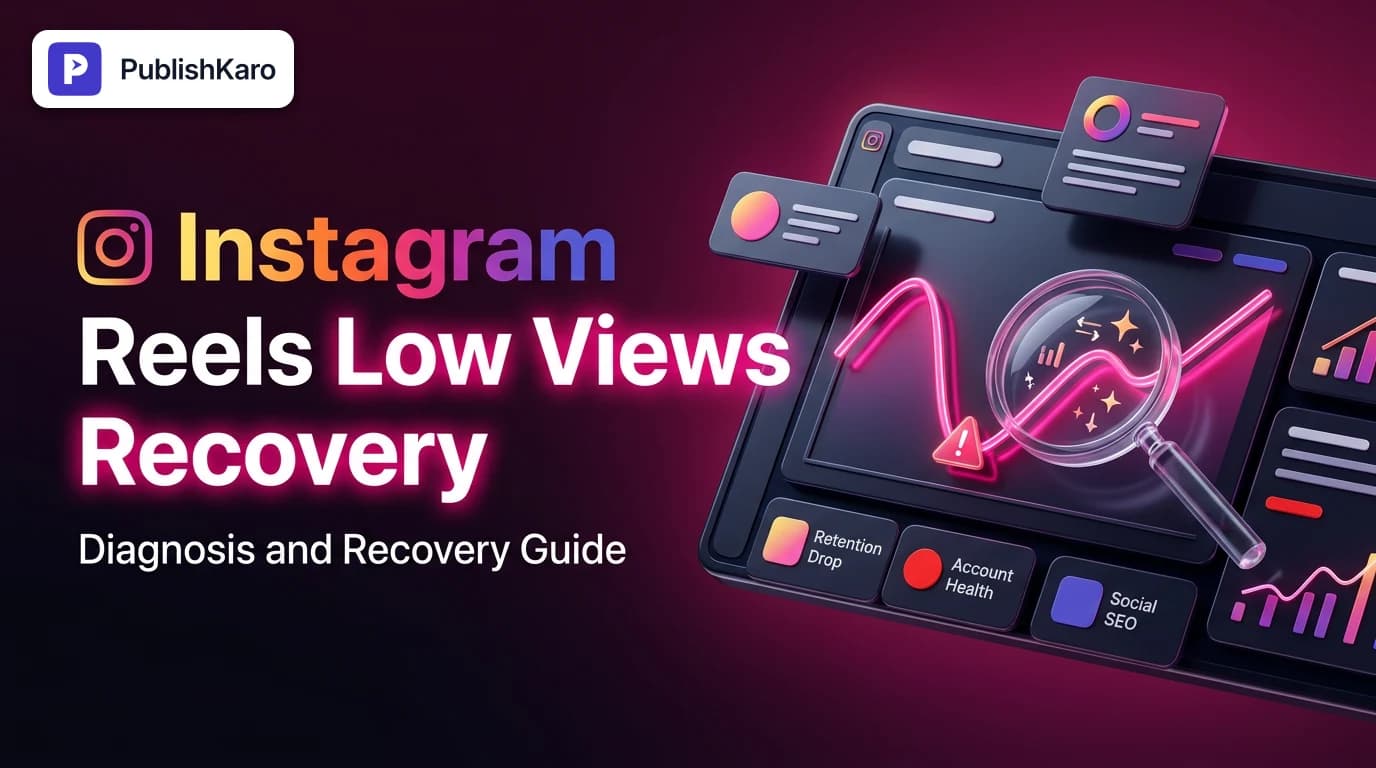
Understanding How Instagram Decides Reel Reach
A steep downturn in short-form video views feels sudden, but platform distribution operates on measurable viewer interaction. When you tap publish on a new video, the platform does not blast it to every profile following your page. Instead, it serves the asset to an initial testing group composed of active followers and selected non-followers whose watch histories mirror your topic.
Guidance documented in the Meta Business Help Center confirms that content recommendation algorithms prioritize authentic video formats that hold attention and foster direct engagement, while limiting content that features low quality, watermarks, or community guideline flags. When your numbers decline, your profile has not been permanently silenced. Instead, your recent uploads have simply failed to generate the necessary engagement signals required to clear subsequent testing cohorts.
Understanding these algorithmic distribution tiers removes emotional guesswork from video marketing. Rather than abandoning short-form video, creators and brand teams can methodically address structural weaknesses in their creative workflow. For businesses seeking a dependable social infrastructure, pairing regular creative output with full-funnel social media services helps establish sustainable audience acquisition.
The Primary Causes of Declining Reels Views
Diagnosing an ongoing view slump requires evaluating retention patterns, community behaviors, and technical file traits. Below are the five most prevalent issues responsible for sudden reach reductions.
1. Retention Drop-Off in the First 3 Seconds
Viewer attention is exceptionally fleeting on mobile feeds. If your clip begins with a slow fade, an animated corporate intro, or a speaker introducing themselves, viewers swipe upward immediately. The recommendation engine evaluates early swipe-aways as direct evidence that the clip failed to satisfy interest. When early drop-off dominates your viewer metrics, the platform immediately throttles explore recommendations.
2. Lack of Direct Message Shares (Sends)
While simple likes and comments remain noticeable, internal messaging signals represent the most influential distribution factor across modern social feeds. When an individual forwards your clip to a peer via direct message, the platform interprets that interaction as strong proof of conversational value. Content centered exclusively on company self-promotion rarely triggers shares, creating an artificial ceiling on total video exposure.
3. Visible Watermarks and Compression Artifacts
Recommendation engines deliberately down-rank videos carrying third-party logos, watermarks from competing social apps, or pixelated compression artifacts. If you export a video from an external video app and publish it with embedded branding, distribution is systematically restricted. If your business repurposes vertical creative across channels, follow established procedures for cross-posting Instagram Reels to YouTube Shorts using clean master files rather than screen recordings.
4. Fragmented and Unpredictable Posting Cadences
Publishing erratically distorts your engagement baselines and disrupts follower viewing habits. Posting five videos in one day followed by three weeks of silence deprives your brand of reliable audience feedback. Organizing a dependable production pipeline using the PublishKaro publishing app allows marketing teams to stage content cleanly through official APIs, preserving original file resolutions as detailed in the official Instagram Platform Documentation.
5. Algorithmic Topic Disconnect and Content Resets
Your historic followers might no longer care about your recent business topics. If your early followers followed you for personal updates or obsolete offers, they will skip past your new service tutorials. When your immediate followers scroll past, Instagram concludes the video lacks interest. Creators facing persistent topical mismatches can learn how recommendation systems adjust preferences by reviewing our guide on how to reset Instagram suggested content.
Comparison Table
Comparing underperforming Reels against high-distribution assets highlights where technical and creative adjustments make the biggest impact.
| Performance Indicator | Low-View Reels (Stalled Reach) | High-Performing Reels (Expanded Reach) |
|---|---|---|
| Opening Visual Hook | Static graphic, delayed movement, or branded splash screen | Immediate action, punchy visual context, or bold on-screen statement |
| Initial Retention Rate | Steep viewer drop-off in the first 2 seconds | Strong retention curve through the halfway mark of the video |
| Dominant Engagement Type | Passive double-taps or brief surface likes | High volume of direct message sends, bookmarks, and re-watches |
| Technical File Quality | Heavy compression, platform watermarks, low-bitrate audio | Clean 1080x1920 MP4, original high-bitrate audio, balanced lighting |
| Safe Margin Adherence | Text overlays covered by caption text or UI icons | Centered typography framed safely away from edge engagement icons |
| Caption & Social SEO | String of unrelated generic hashtags with zero context | Contextual, searchable description with relevant industry keywords |
| Creative Focus | Broad corporate announcements with no audience payoff | Targeted problem-solving or clear entertainment tailored to a specific niche |
Visual guide
Instagram Reels Algorithmic Testing Funnel
How Instagram tests new video uploads with small cohorts before expanding distribution to explore feeds and non-followers.
Diagnosing Audience Retention Drop-Offs
Identify why viewers leave your Reels by matching your retention curve against specific production fixes.
Step-by-Step Account Recovery Process
Follow these practical recovery steps to eliminate reach penalties and restore organic Reels distribution.
Practical Examples
Reviewing real-world diagnostic scenarios shows how small tactical shifts rebuild viewer retention across diverse business categories.
Example 1: Local Commercial Bakery Facing Stalled Video Distribution
A family-owned artisan bakery experienced an unexpected drop in their video performance, sliding from an average of 6,000 views down to under 400 views per post. An audit of their account revealed that each video opened with a four-second static title slide announcing their daily operating hours, set against a quiet kitchen background.
- The Strategy Adjustment: The bakery discarded static opening slides completely. Instead, their videos began immediately with dynamic, close-up movement—such as slicing into freshly baked sourdough bread while crisp ambient kitchen audio played. They layered short, conversational text overlays across the middle of the frame.
- The Metric Outcome: Viewers stopped swiping past during the opening seconds. By replacing a static corporate slide with immediate visual motion, their average watch duration rose significantly, leading to increased local bookmarks and organic feed distribution.
Example 2: B2B Technology Consultancy With Low DM Engagement
A boutique enterprise software consulting agency consistently produced technical tutorials on workplace automation. Despite high video production quality, their views plateaued at roughly 250 views per clip, with audience members dropping off before the clip reached its midpoint.
- The Strategy Adjustment: The agency realized their videos offered broad industry commentary rather than tactical utility that peers would share. They restructured their videos into focused 12-second tutorials solving a specific operational headache: replacing manual data entry with simple script shortcuts. They added an explicit prompt encouraging viewers to send the tip to their operations teammates.
- The Metric Outcome: Direct message shares surged. Because Instagram's distribution signals reward content that circulates privately among active users, the clips pushed through their initial follower tier into broad professional explore feeds.
Example 3: Boutique Fitness Apparel Brand Resolving Export Quality Issues
An independent activewear label noticed their styling reels suffered an ongoing reach deficit after they switched video editing contractors. The team was saving draft files directly off consumer smartphone apps, resulting in visible compression artifacts, muddy audio, and subtle third-party interface watermarks along the margins.
- The Strategy Adjustment: The team eliminated secondary app exports and returned to raw master footage. They standardized export settings at 1080x1920 pixels at 30 frames per second using high-bitrate encoding. They reviewed account standards in Instagram's Account Status menu to confirm no music copyright restrictions were throttling reach.
- The Metric Outcome: Eliminating visual artifacts and third-party compression immediately cleared algorithmic quality filters, restoring standard reach across non-follower recommendations.
Step-by-Step Diagnostic and Recovery Framework
When your content experiences a sudden reach drop, follow this structured six-step recovery roadmap to isolate and repair your publishing workflow.
Step 1: Verify Recommendation Status in Account Settings
Before rewriting your creative scripts, confirm that your profile is not restricted by administrative flags. Open the Instagram app, navigate to your profile, tap the hamburger menu in the upper corner, select Settings and Privacy, and scroll down to Account Status.
Ensure that green checkmarks appear next to all categories, particularly Content that can't be recommended. If a prior upload violated community standards, intellectual property rules, or commercial licensing limits, the platform may temporarily exclude your profile from explore and non-follower suggestion surfaces. Removing or appealing flagged posts is the vital first step toward restoring distribution.
Step 2: Audit Watch Curves in Professional Insights
Open the analytics dashboard for your five lowest-performing recent videos and study the Audience Retention graph for each post.
- Immediate vertical drop at 0 to 2 seconds: Your visual hook is failing. Viewers are scrolling away before identifying the topic.
- Gradual downward slide across the middle: Your pacing is too slow, audio delivery lacks energy, or the video takes too long to get to the point.
- Flat retention curve but low total reach: The video retained its viewers, but failed to generate engagement signals like direct message shares or saves. In this scenario, your content is interesting to the individual but lacks conversational or practical utility.
Step 3: Redesign the Opening Two Seconds
To stop viewers from scrolling, create rapid visual and auditory contrast. Avoid predictable greetings such as "Hey everyone, welcome back to our page." Open directly on the primary subject, incorporate natural camera movement, or use a concise on-screen text hook that addresses a specific frustration.
Developing strong, recognizable visual templates helps maintain aesthetic cohesion as your publishing volume scales. If your team is standardizing creative assets across platforms, our detailed guide on how to build brand guidelines for small business covers how to organize core typography, palette rules, and framing margins for maximum brand recall.
Step 4: Optimize Content for Social Search Discovery
Instagram relies on text recognition, automated transcription, and caption metadata to index vertical video. Treat your captions as descriptive search summaries rather than dumping dozens of irrelevant hashtags at the end of the post.
Integrate relevant, natural phrasing that prospective clients would realistically type into a search bar. Optimizing your social descriptions for topical relevance closely parallels organic search mechanics. Teams wanting to understand how search platforms index topical context can review Google's SEO Starter Guide for universal discoverability principles.
Step 5: Diversify Creative Formats and Production Styles
If your direct-to-camera videos continue to stall, test alternative creative frameworks. Publish brief 8-second text loops, high-tempo screen demonstrations, kinetic motion explainers, or behind-the-scenes workflow sequences.
PublishKaro provides dedicated video production services for businesses seeking professional creative support. Our published rates include video editing for every feed at ₹1,000–₹5,000 per 1-minute video, motion graphics reels at ₹2,000–₹5,000 per 1-minute video, animated-film style 3D at ₹4,000–₹10,000 per 1-minute video, and AI video at ₹3,000–₹10,000 per 1-minute video. All other creative, development, and strategic projects are quoted after a free call, at a fixed price agreed in writing.
Step 6: Build Sustainable Multi-Channel Audiences
Relying on a single social platform leaves your revenue exposed to algorithmic updates. Forward-thinking brands balance their short-form social presence with owned digital infrastructure.
Complementing your social campaigns with high-converting owned assets through custom website development ensures you capture inbound interest regardless of social reach volatility. Similarly, pairing organic publishing with targeted advertising management and organic discoverability through SEO and Google Business services establishes stable lead generation across every customer touchpoint.
Checklist
Review this pre-publishing checklist before uploading your next short-form video asset.
- Account Health Confirmed: Account Status shows clean checkmarks with zero recommendation restrictions.
- Instant Hook Positioned: The primary visual movement and topic hook appear within the first 1.5 seconds.
- Clean Source Files: Video contains zero external app logos, compression noise, or visible watermarks.
- Safe Zone Verification: Text elements sit within center margins, completely unobstructed by feed icons.
- Crisp Visual Encoding: Video is rendered at 1080x1920 pixels with smooth framerates and clean lighting.
- Legible Captions Included: High-contrast captions are integrated for users watching with sound turned off.
- Audio Licensing Verified: Music or sound effects comply with commercial licensing standards.
- Descriptive Caption Written: Post copy includes natural, searchable terms related to your industry.
- Clear Sharing Trigger: The content delivers a practical tip, humorous insight, or relatable point worth sending via DM.
Key Takeaways
- Algorithmic reach follows measurable retention: A sudden drop in Reel views indicates that recent uploads failed initial retention and engagement testing thresholds.
- The first two seconds determine distribution: Opening with slow branded title cards prompts immediate scroll-aways that signal poor engagement to the algorithm.
- Direct message shares expand your audience: Prioritize content that provides tangible utility, actionable tips, or relatable moments that viewers naturally send to colleagues.
- Protect your account recommendation status: Regularly monitor Account Status under settings to verify that no copyright or community flags are restricting explore reach.
- Treat captions as search metadata: Write clear, keyword-rich captions so platform algorithms can index and serve your videos to interested searchers.
- Diversify beyond a single feed: Balance your short-form social content by exploring resources on our PublishKaro blog and investing in owned channels that preserve audience relationships over the long term.
Frequently asked questions
Why did my Instagram Reels views drop from thousands down to hundreds?
A sudden drop in Reel views usually occurs when recent uploads fail early viewer retention tests. If your initial testing group swipes away within the first two seconds, the platform stops serving the video to wider explore audiences. It can also occur if your profile has recommendation flags inside your Account Status settings.
Does using popular or trending audio increase Reel views?
Using popular audio can help if the sound aligns naturally with your video's pacing, but it will not compensate for a weak visual hook or poor watch time. The platform evaluates total retention and viewer shares far more heavily than the background audio track alone.
How often should a business post Instagram Reels each week?
For most small and medium brands, posting three to five high-quality, well-paced Reels per week produces better algorithmic signals than publishing multiple rushed videos daily. Consistent, high-retention uploads protect your baseline engagement metrics across testing pools.
Can editing Reels outside of Instagram hurt my distribution?
No, editing in third-party desktop or mobile software does not hurt your reach as long as the exported video file is high resolution (1080x1920) and completely free of third-party platform watermarks. Instagram restricts videos that display external logos or noticeable compression artifacts.
What is the ideal video length for an Instagram Reel?
While Reels can run up to 90 seconds, videos between 7 and 15 seconds generally achieve higher completion and replay rates. Longer formats should only be used when delivering detailed educational breakdowns that hold viewer attention throughout the entire runtime.
How long does it take to recover from an Instagram Reels view slump?
Most accounts begin recovering their baseline reach within two to three weeks of consistent, high-retention publishing. Focus on delivering immediate visual hooks, encouraging direct message shares, and confirming that your Account Status remains completely free of recommendation restrictions.