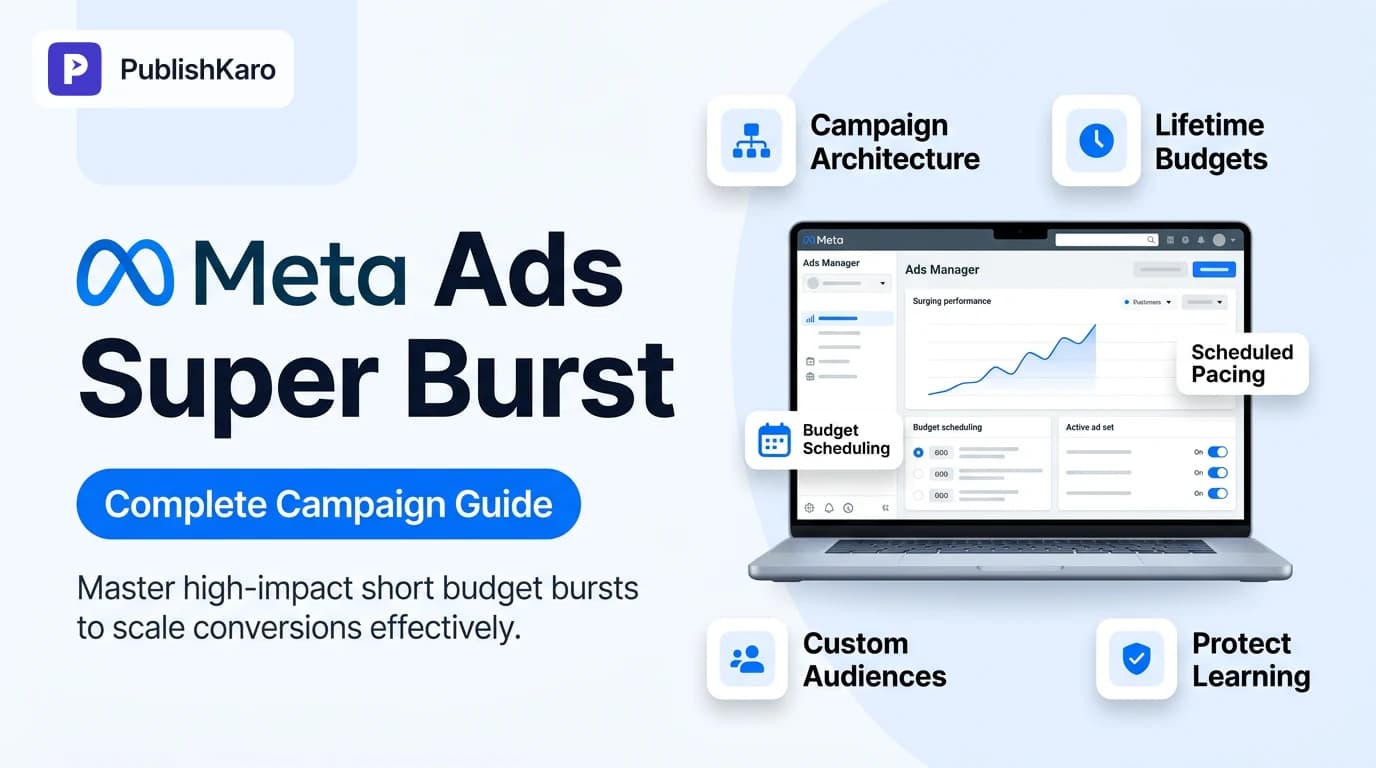
What Is a Meta Ads Super Burst Campaign?
A super burst campaign is an intensive advertising setup on Meta platforms (Facebook and Instagram) designed to concentrate spend within a condensed time window. Unlike evergreen strategies that rely on consistent daily budgets and sustained delivery, a super burst aims to capture maximum immediate market share during flash sales, product drops, seasonal holidays, or major product announcements.
Executing high-velocity ad spend requires strict setup parameters. Standard daily budget adjustments can cause campaign volatility. In traditional media buying, increasing a daily ad set budget by more than 20% often pushes the ad set back into the learning phase. A super burst bypasses this disruption by creating an isolated environment tailored for rapid ad delivery. To review official documentation on auction mechanics and budget pacing, refer to the Meta Business Help Center.
If you are already managing baseline traffic or multi-channel acquisition alongside Google Ads management, understanding how an isolated surge interacts with overall cross-platform visibility is critical. Knowing the nuances of a structured meta ads burst campaign strategy allows marketing teams to deploy aggressive short-term capital without throwing evergreen ad sets into algorithmic turmoil.
Why and When to Deploy a Super Burst
A super burst is not meant to replace ongoing customer acquisition. It is an intentional tactic suited for specific commercial moments:
- Flash Sales and Clearance Events: When an e-commerce business runs a 48-hour promotional discount, slow ad delivery leaves potential revenue on the table.
- Product Launches: Concentrating visibility within the first 72 hours helps kickstart social proof, initial orders, and immediate algorithmic engagement across social feeds.
- Seasonal Peaks (Black Friday, Cyber Monday, Festive Seasons): High buyer intent justifies paying higher auction prices to secure transactions before deadlines pass.
- Event Ticket Sales or Cart Close Deadlines: When deadlines arrive, late spend must deploy rapidly to reach interested prospects before the final countdown ends.
Executing this effectively requires dependable infrastructure. If your destination is an e-commerce storefront, ensure your technical speed is stabilized beforehand. Technical lag can diminish burst returns; our guide on how to fix Shopify Interaction to Next Paint (INP) covers how page responsiveness directly protects advertising conversion rates during peak traffic.
Key Architectural Decisions Before Campaign Setup
Before opening Meta Ads Manager, define three core structural decisions: budget distribution type, attribution windows, and audience layering.
Lifetime Budget vs. Daily Budget
For a super burst, lifetime budgets paired with campaign budget optimization (Advantage Campaign Budget) are vastly superior to daily budgets. When you set a lifetime budget with a specific start and end timestamp, Meta's auction pacing algorithms automatically distribute spend to capture optimal conversions across the designated duration rather than strictly dividing spend evenly across 24-hour cycles. This reliance on facebook ads lifetime budget pacing ensures that spend dynamically spikes when target buyers are active, rather than artificially tapering off at arbitrary midnight cutoffs.
Attribution Windows
Burst events shorten the evaluation timeframe. If your campaign only runs for three days, relying solely on 7-day click or 1-day view attribution models may distort real-time performance evaluation. To master how tracking adjustments change reported return on ad spend, consult our guide on Meta ads engage-through attribution settings.
Creative Asset Readiness
Ad fatigue occurs rapidly under heavy burst budgets. Showing the exact same static visual eight times to a user in 48 hours suppresses click-through rates. Successful burst strategies involve preparing dynamic variations, short-form reels, motion graphics, and bold promo banners. Many brands tap into dedicated video and motion services and design and branding assets to produce high-contrast, deadline-driven creative sets before launching a burst.
Step-by-Step: How to Set Up Meta Ads Super Burst
Follow these sequential technical steps inside Meta Ads Manager to configure your super burst correctly without disrupting your broader paid ad ecosystem.
Step 1: Create an Isolated Campaign
Do not inject your burst budget directly into existing evergreen campaigns. Doing so introduces severe learning-phase volatility.
- Log in to Meta Ads Manager.
- Click the green + Create button.
- Select your campaign objective. For direct sales, choose Sales (or Leads if capturing sign-ups).
- Name the campaign clearly with an identifiable naming convention, such as:
BURST_Sales_FlashSale_[Date]. - Keep Advantage Campaign Budget (CBO) enabled, set your total Lifetime Budget, and continue to the ad set level.
Step 2: Configure Delivery Schedule and Pacing
- In the Ad Set settings, navigate to Budget & Schedule.
- Define the exact Start Date/Time and End Date/Time. For peak flash promotions, setting ad launch times around early morning hours (e.g., 05:00 AM local time) gives the delivery system an opportunity to stabilize before peak mobile browsing periods.
- Under Ad Scheduling, you can run ads continuously through the duration or specify delivery hours if your conversion event requires live support teams.
Step 3: Audience Structuring (Broad vs. Retargeting)
In a super burst campaign, audiences must be wide enough to absorb accelerated spend without immediate saturation:
- Ad Set 1 (Warm / High-Intent Audience): Consisting of 30-day website visitors, past purchasers, email list custom audiences, and social media engagers. Even during a burst, you should align your paid push with automated workflows like email marketing to capture subscribers who miss the initial ad delivery.
- Ad Set 2 (Broad / Advantage+ Audience): Target your core demographic with open targeting, allowing Meta's algorithms to discover in-market buyers based on creative hooks and historical checkout patterns.
Step 4: Asset Selection and Placement Configuration
Use Advantage+ Placements to allow the delivery engine flexibility to bid across Facebook Feeds, Instagram Reels, Stories, and Audience Network. Restricting placements during a super burst can artificially constrain delivery and spike your cost per thousand impressions (CPM).
If you publish supporting organic media simultaneously, managing announcements from a unified calendar like the PublishKaro publishing app ensures social copy stays aligned with your live Meta ad offers without disjointed messaging.
Step 5: Setting Bid Caps or Accelerated Pacing
For most businesses, the default "Highest Volume" bid strategy works best during bursts, as it maximizes delivery within the assigned budget. However, if your margins are exceptionally thin, configure a "Cost per Result Goal" or "Bid Cap". Be aware that aggressive bid caps during a burst can throttle delivery entirely if your cap falls below real-time auction clearing prices.
Comparison Table
Understanding how a super burst operates relative to standard evergreen scaling helps media buyers determine when to switch strategies.
| Feature / Metric | Evergreen Scaling Campaign | Meta Ads Super Burst Campaign | Aggressive Daily Budget Bump |
|---|---|---|---|
| Primary Objective | Steady, consistent customer acquisition | Concentrated conversion volume in narrow windows | Fast budget scaling within existing structures |
| Recommended Budget Type | Daily Budget | Lifetime Budget | Daily Budget |
| Duration | Ongoing / Indefinite | 48 to 96 hours | Ongoing |
| Risk of Learning Phase Reset | Low (managed via small budget increments) | None to existing campaigns (isolated campaign) | Extremely High (if budget jumps >20%) |
| CPM Volatility | Low to moderate | High (due to compressed delivery) | High |
| Audience Saturation Risk | Low over time | Moderate (mitigated by wide targeting & variations) | Moderate to High |
| Creative Requirements | Consistent rotation (weekly/monthly) | High-contrast, dynamic, urgency-focused assets | Standard assets |
| Attribution Window Focus | 7-day click, 1-day view | 1-day click or real-time event tracking | 7-day click, 1-day view |
Visual guide
Choosing Your Flash Scaling Method
Evaluate your campaign duration to avoid resetting Meta's algorithmic learning phase during sudden budget spikes.
Two-Audience Burst Campaign Structure
Split your short-term ad spend across warm buyers and broad targeting to prevent creative fatigue and auction bottlenecks.
From Goal to Live Result
The path a how to set up meta ads super burst project follows, from agreeing the goal to measuring the result.
Practical Examples
Examining specific deployment patterns highlights how varying business models implement burst campaigns in competitive advertising ecosystems.
Example 1: E-commerce 72-Hour Flash Sale
A direct-to-consumer apparel brand hosted an annual clearance event spanning Friday morning to Sunday night. Instead of adjusting their existing product catalog campaigns, the marketing team created a separate super burst campaign with a 72-hour lifetime budget.
- Ad Set Structure: One warm audience consisting of past 90-day purchasers and add-to-cart drops; one broad audience utilizing Advantage+ targeting.
- Creative Execution: Video motion reels showcasing top-selling SKUs with distinct "Ends Sunday Midnight" typography.
- Outcome: The lifetime budget paced evenly across the promotional period. The evergreen baseline campaigns continued uninterrupted, avoiding unnecessary algorithmic re-entry into the learning phase.
Example 2: B2B Early-Bird Ticket Drive
A corporate training platform needed to close registration for an upcoming summit within four days before ticket prices doubled. Because corporate buyers rely on internal approvals, the team paired targeted paid ads with an AI conversational assistant on their site, similar to setups deployed through AI chatbots & WhatsApp automation, to field instant queries about corporate invoicing.
- Setup: Meta Ads Super Burst running on Lead Generation and Sales objectives.
- Ad Format: Single image banners combined with short testimonial clips highlighting speaker credibility.
- Outcome: High delivery velocity captured late registrations before the price increase, while the customer support chat handled real-time objections from prospective attendees.
Checklist
Use this operational checklist before, during, and after executing your super burst campaign.
Pre-Launch Preparation
- Define the promotion window (ideal: 48–96 hours) with exact start and end timestamps.
- Calculate total lifetime budget allocation without borrowing from profitable evergreen sets.
- Verify that conversion tracking pixels and Conversions API (CAPI) are operational.
- Review technical store speed and confirm checkout stability; review Google Search Central SEO guidance if high incoming traffic lands on indexable pages.
- Prepare dynamic creative assets: vertical video reels, single-image banners, and bold urgency copy.
- Set up automated transactional emails to confirm orders swiftly.
Campaign Configuration
- Create an isolated campaign outside your primary scaling campaigns.
- Select Campaign Budget Optimization with Lifetime Budget.
- Configure Ad Sets with comprehensive Advantage+ placements.
- Exclude recent purchasers from top-of-funnel burst sets to prevent ad spend waste.
- Verify that discount codes and destination landing page URLs match across all ads.
In-Flight Monitoring & Optimization
- Review spend pacing 4 hours post-launch to confirm delivery initiation.
- Track ad frequency. If frequency exceeds 4.0 within 24 hours on retargeting sets, widen the audience size.
- Check conversion values against actual backend store metrics to identify tracking discrepancies.
- If delivery falls behind schedule, ensure bid caps are not artificially restricting auction wins.
Post-Campaign Protocol
- Confirm automated campaign termination at the scheduled end time.
- Compile comprehensive metrics: Blended ROAS, CAC, Total Conversions, and CPM variance.
- Extract top-performing creative concepts to iterate into your evergreen testing queues.
- Re-engage burst buyers through post-purchase email onboarding sequences.
Key Takeaways
- Isolate Your Burst: Never attempt a super burst by inflating budgets inside evergreen ad sets. Always run bursts in separate campaigns with dedicated lifetime budgets.
- Use Lifetime Budgets: Lifetime budgets enable Meta's delivery algorithms to pace auction bidding dynamically around high-opportunity time periods.
- Ensure Creative Variety: Rapid spending exhausts ad creative quickly. Run multiple formats—such as motion graphics, product cuts, and static images—to prevent ad fatigue.
- Balance Warm and Broad Pools: Combining retargeting lists with broad Advantage+ targeting prevents ad saturation while capturing high-intent shoppers.
- Keep Technical Foundations Resilient: Fast-loading websites and responsive customer service integrations ensure that high-velocity traffic translates into completed sales.
For marketing teams seeking strategic execution, exploring professional ads management alongside multi-channel services—ranging from custom Shopify stores and WordPress sites to continuous social media management—provides the foundational stability required for rapid scaling.
Frequently asked questions
What is a Meta ads super burst?
A Meta ads super burst is a short-duration advertising campaign designed to deliver high budget volume over a compressed window, typically 48 to 96 hours. It leverages lifetime budgets and automated pacing to maximize sales during product drops, flash events, or seasonal promotions without destabilizing evergreen campaigns.
Will running a super burst ruin my account's learning phase?
No, provided you build the super burst inside an isolated campaign. If you drastically raise the daily budget on an existing evergreen campaign, you will likely reset its learning phase. Creating a separate campaign dedicated entirely to the burst preserves your ongoing baseline optimization.
Should I use lifetime or daily budgets for a super burst?
Lifetime budgets are strongly recommended for super bursts. When paired with precise start and end times, a lifetime budget allows Meta's system to bid flexibly across the campaign's lifespan, optimizing spend distribution during the hours when users are most likely to convert.
How many creative assets should I prepare for a burst campaign?
You should deploy at least 3 to 6 distinct ad variations across formats like vertical reels, carousels, and bold single-image banners. Because high spend accelerates ad frequency rapidly, creative diversity prevents fatigue and maintains strong click-through rates throughout the promotion.
What should I do if my super burst is not spending its budget?
If your burst under-spends, inspect your bidding strategy and audience sizing. Restrictive bid caps often choke delivery in competitive auctions. Switching to Highest Volume bidding, expanding your audience via Advantage+ settings, and removing placement restrictions will generally restore proper spend pacing.
Can service businesses run super bursts, or are they only for e-commerce?
Service businesses can effectively run super burst campaigns for time-sensitive events such as webinar sign-ups, early-bird workshop enrollments, or seasonal consultation openings. The key is ensuring that your conversion mechanism and response team can handle sudden influxes of inquiries.
Explore more marketing strategies and tactical frameworks on the PublishKaro blog or browse our specific ads category resources to expand your paid acquisition capabilities.